Ante's law, IROPZ index, diagnostic wax-up, occlusal concepts, crown-to-root ratio and All-on-4
ICD-10: Z46.3
Planning Principles and Sequence
Prosthodontic treatment planning is a systematic process comprising comprehensive oral status assessment, evaluation of occlusion and the TMJ, biomechanically driven prosthesis selection, abutment preparation and long-term prognosis. Core principle: minimally invasive treatment achieving maximum functional and aesthetic rehabilitation.
Mandatory sequence: 1) elimination of active disease (caries, pulpitis, periodontitis, periapical foci); 2) occlusal and TMJ assessment; 3) diagnostic wax-up for complex cases; 4) prosthesis and abutment selection with Ante's law calculation; 5) tooth preparation and fabrication; 6) dynamic monitoring.
Principle: Minimal invasiveness — Tissue preservation is the priority
Ante's law: ΣS_abutments ≥ ΣS_replaced — Sum of abutment PDL ≥ sum of replaced PDL
Diagnostic wax-up: Mandatory — For wear Degrees II–III and complex reconstructions
Patient consent: Written — Informed consent before any tooth preparation
Ante's Law and Abutment Calculation
Ante's law (1926): the combined PDL (periodontal ligament) surface area of all abutment teeth must equal or exceed the combined PDL surface area of all teeth to be replaced. Formula: ΣS_abutments ≥ ΣS_replaced.
Example for a Kennedy Class I RPD (missing 36, 37 left and 46, 47 right): teeth to replace — 36 (433) + 37 (431) + 46 (433) + 47 (431) = 1728 mm². Proposed abutments 35, 34, 33 left + 45, 44, 43 right: 215 + 220 + 273 + 215 + 220 + 273 = 1416 mm². Ante's law NOT met → fixed bridge is absolutely contraindicated; RPD using all remaining teeth as abutments, or implant-supported restoration, is required.
IROPZ Index and Choice of Single-Tooth Restoration
IROPZ (Milikevich index of destruction of the occlusal surface; no established English equivalent) = defect area / total occlusal surface area. The value 0.0–1.0 directly determines the type of indirect restoration required.
| IROPZ | Restoration | Rationale |
|---|---|---|
| ≤ 0.3 | Inlay / onlay | Most tooth structure preserved — indirect ceramic or alloy inlay |
| 0.3–0.6 | Inlay or full-coverage crown | Borderline zone: decision based on location, aesthetics, vitality |
| 0.6–0.8 | Crown on core build-up | Significant destruction — cast post-core or zirconia core + crown |
| > 0.8 | Post-retained crown | Crown destroyed to gingival level — root post + core + crown; poor prognosis → consider implant |
Diagnostic Workflow
Study models and articulator mounting — Alginate or A-silicone impressions. Class III dental stone casts mounted on a semi-adjustable articulator (e.g. Whip-Mix, Artex) via facebow transfer. Centric relation (CR) registration using leaf gauge or Lucia jig and silicone bite record. (Facebow, semi-adjustable articulator, CR bite record)
Diagnostic wax-up — Wax sculpting of the planned tooth forms on mounted casts in the articulator. Purpose: agree tooth shape, VDO and occlusal scheme BEFORE any preparation. Basis for provisional crowns and DSD. (Modelling wax, carvers, articulator)
Digital Smile Design (DSD) — For aesthetic cases: full-face and intraoral photographs + digital overlay of planned result. Allows patient to visualize and approve the aesthetic outcome before treatment begins. Exported to CAD/CAM for provisional fabrication. (DSD software, full-face and profile photographs)
Provisional restorations — Acrylic provisional crowns fabricated from the wax-up or DSD. Worn 3–6 months. Purpose: verify occlusal scheme, phonetics, aesthetics and patient tolerance of the increased VDO BEFORE fabricating definitive restorations. (Bisacryl or PMMA provisional material, provisional cement) (3–6 months)
Definitive restorations — After a successfully evaluated provisional period: A-silicone or polyether final impressions, definitive cementation of PFM or zirconia crowns. Evaluate at try-in: marginal fit, contacts, shade, phonetics. (PFM (metal-ceramic) or monolithic zirconia dioxide)
Occlusal Concepts in Prosthodontics
Selecting the correct occlusal scheme is critical when restoring multiple teeth or undertaking full-mouth rehabilitation. Two principal concepts are used: Mutually Protected Occlusion (MPO) and Group Function.
MPO Mutually Protected Occlusion — Posterior teeth protect anterior teeth in centric occlusion: even bilateral posterior contacts distribute load across the arch in CO, keeping anterior teeth out of heavy contact. Anterior teeth protect posterior teeth in eccentric movements: during lateral and protrusive excursions, the anterior teeth (canines / incisors) bear the load and posterior teeth disclude. Gold standard for most prosthodontic rehabilitations.
Canine guidance Canine-protected articulation — A specific form of MPO: during lateral excursions, the canine bears the entire eccentric load and all posterior teeth are immediately discluded. Advantage: maximum protection of posterior teeth. Contraindication: weak or compromised canine abutment.
Group function Lateral group function — Alternative to canine guidance: during lateral excursion, the load is shared among multiple working-side teeth (canine + premolars ± first molar). Indicated with a short or worn canine, deep overbite, or compromised canine prognosis.
CR vs CO Centric relation vs Centric occlusion — Centric relation (CR) is the reproducible, condyle-in-fossa reference position (most superior, anterior, non-medial). Centric occlusion (CO) is maximum intercuspation. Ideally they coincide or are within 1 mm. All restorations are fabricated in CR when VDO changes are planned.
Prosthesis Types
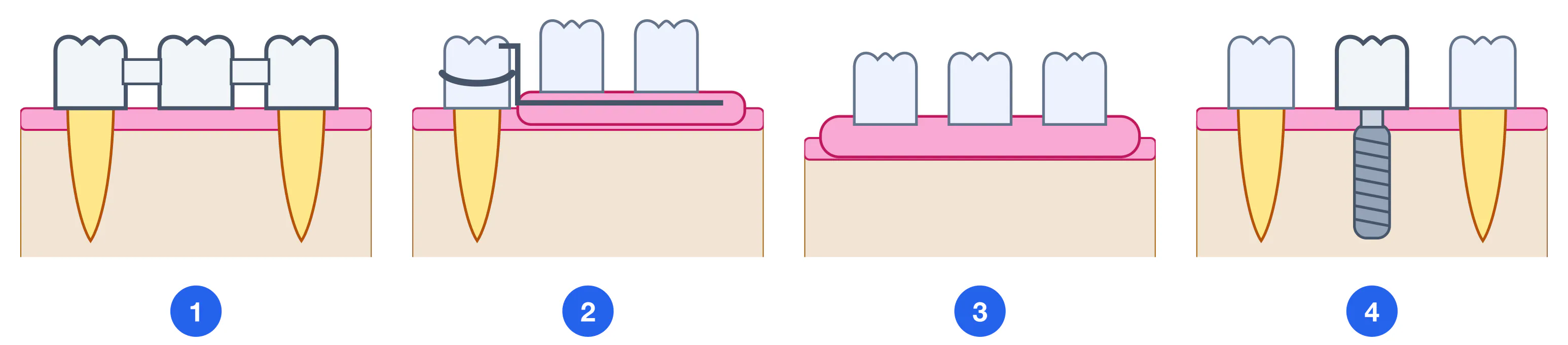
| Prosthesis type | Indications | Advantages | Disadvantages |
|---|---|---|---|
| Fixed (crown/bridge) | Single defect, span ≤3 teeth, Ante's law met | Fixed, high aesthetics, comfort | Abutment preparation required, span limitation |
| Partial RPD (clasp) | Kennedy Class I–III, multiple defects | Preserves abutments, economical | Discomfort, visible clasps, hygiene demands |
| Complete denture | Complete edentulism, no implant option | Accessible, solution for total loss | Poor retention, progressive bone resorption |
| Implant + crown | Single/multiple defect, adequate bone volume | No preparation of adjacent teeth, durable | High cost, treatment time (3–6 months), surgery |
| All-on-4 / Overdenture | Complete edentulism with adequate bone for 4 implants | Fixed or removable full-arch solution | Cost, hygiene complexity, surgical procedure |
Crown-to-Root Ratio and Abutment Criteria
The crown-to-root ratio compares the clinical crown length to the bone-supported root length. Ideal: 1:2; acceptable: 1:1.5; borderline: 1:1; unfavourable: >1:1 (crown longer than root). Borderline abutments (1:1) may be acceptable only in short spans, healthy periodontium, splinted abutments or with an additional abutment added to the design.
| Abutment criterion | Acceptable | Borderline | Contraindication |
|---|---|---|---|
| Probing depth | ≤ 3 mm | 3–5 mm post-periodontal treatment | > 5 mm or active periodontitis |
| Bleeding on probing | Negative | Positive in ≤20% of sites | Positive in >20% of sites |
| Bone loss | ≤ 1/3 of root length | 1/3–1/2 with no mobility | > 1/2 of root length |
| Tooth mobility | Grade 0 — none | Grade I — within physiological | Grade II–III — contraindication |
| Crown-to-root ratio | 1:2 (ideal) | 1:1.5 — acceptable | ≥1:1 — borderline; >1:1 — contraindication |
All-on-4 and Implant Overdenture
For the completely edentulous patient, two principal implant-based options exist: All-on-4 and the implant-retained overdenture.
All-on-4 (Paulo Malo, 2003): four implants — two axial implants in the anterior region plus two implants tilted 30–45° posteriorly — avoiding the maxillary sinus or inferior alveolar nerve. A full-arch fixed hybrid prosthesis (acrylic teeth on a metal framework) is attached to the implants. Advantage: minimal surgery, immediate loading (often same-day provisional prosthesis).
Implant overdenture: 2–4 implants with locator or ball attachments supporting a removable denture. More affordable alternative; easier for the patient to maintain hygiene; can be relined as the ridge changes.
| Criterion | All-on-4 | Overdenture (2–4 implants) |
|---|---|---|
| Retention | Fixed (removed by clinician only) | Removable (patient removes daily) |
| Number of implants | 4 (minimum) | 2–4 mandible; 4–6 maxilla |
| Oral hygiene | Requires specialist interdental tools | Easier — prosthesis removed for cleaning |
| Cost | Higher | More affordable |
| Bone loading | Even — via metal framework | Partial mucosal load via denture base |
Follow-up Protocol
Initial adaptation — First 2–4 weeks: minor discomfort is normal. Occlusal adjustment at 1–2 weeks if required. Patient instruction on prosthesis hygiene. (2–4 weeks)
Review appointments — Fixed: at 1 month, 6 months, then annually. Removable: at 1 week, 1 month, 3 months (base adjustment as needed). Implants: annual radiographic review, professional hygiene maintenance every 3–6 months. (Annually + every 3–6 months for implant patients)