Systematic overview of hand and rotary instruments. Selection by procedure stage
ICD-10: —
Overview
Dental instruments encompass the full range of hand instruments, rotary tools, handpieces, devices and materials used to carry out diagnostic and therapeutic procedures in the oral cavity. Correct instrument selection at each clinical stage directly determines preparation quality, the volume of tissue removed, and restoration longevity.
Professional classification organizes hundreds of instrument types by functional purpose, design characteristics, and conditions of use. The ISO 6360 international standard unifies the color-coding of burs by grit size, simplifying chair-side selection.
Functional groups: 4 — examination, preparation, restorative, auxiliary
Bur shapes: 10+ — round, fissure, cone, inverted cone…
Turbine speed: 300 000+ — rpm — cutting mode
Low-speed motor: ≤40 000 — rpm — caries removal and finishing
Marking standard: ISO 6360 — ring color = diamond grit
Sterilization: 134 °C — 18 min steam autoclave (Class B)
Hand Instruments
Hand instruments are grouped by functional purpose. Each group is applied at specific procedural stages and is not interchangeable with other groups.
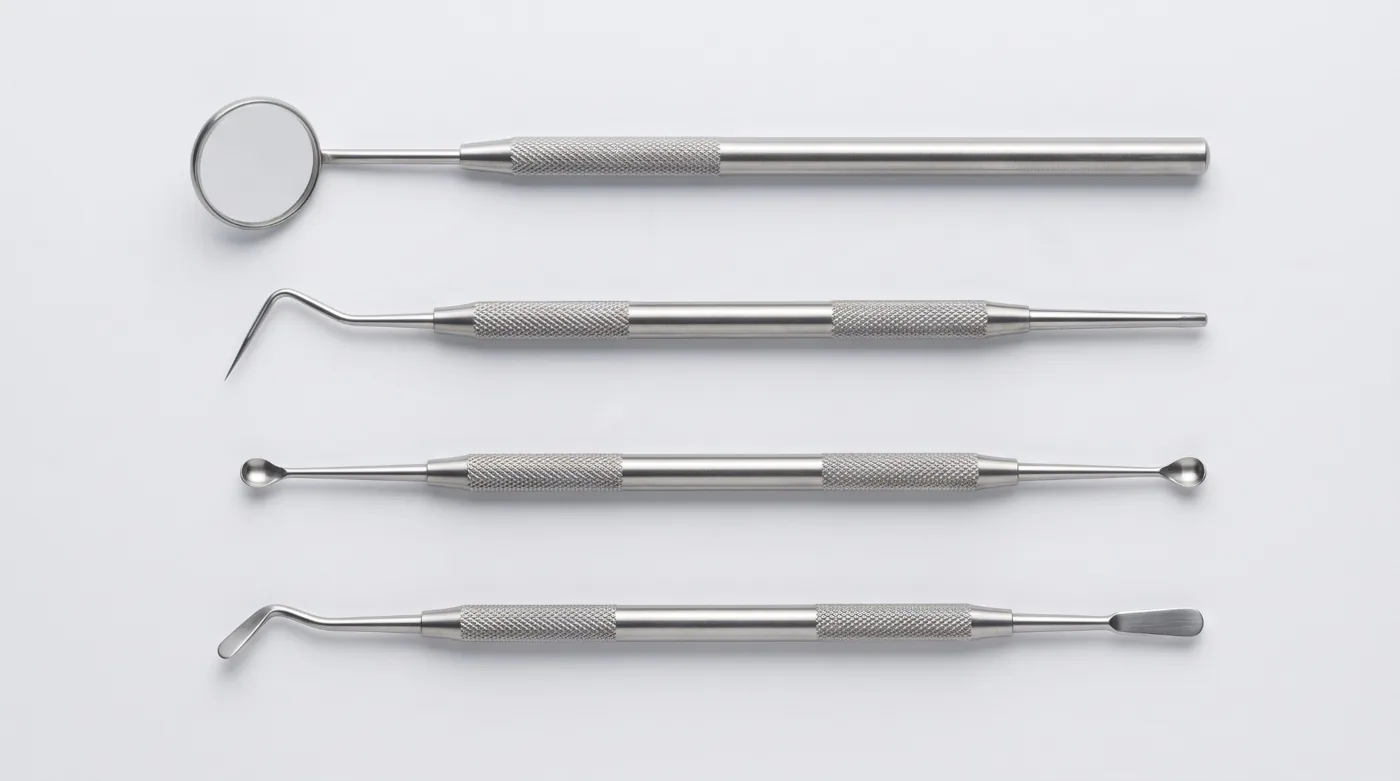
Examination instruments — Angled explorer — probing carious cavities, assessing dentin depth and consistency. Mirror — visualising inaccessible surfaces. Tweezers — transferring items, testing tooth mobility.
Cutting and preparation instruments — Spoon excavator — manual removal of softened carious dentin. Chisel and hatchet — removing unsupported enamel margins.
Restorative instruments — Spatula — mixing glass-ionomer cements and temporary materials. Plastic filling instruments — placing and contouring restorative materials. Plugger — compacting gutta-percha in endodontics. Adhesive brush — applying primer and bond in thin uniform layers.
Finishing and polishing — Articulating paper — identifying premature contacts after restoration. Polishing discs and strips — contouring and finishing proximal surfaces. Rubber cups — polishing with prophylaxis paste.
Auxiliary instruments — Matrix system (retainer + matrix band) — recreating the proximal wall in Class II–IV restorations. Rubber dam (rubber dam clamp + frame) — moisture control and field isolation. Wooden wedges — stabilising the matrix band interproximally.
Bur Classification
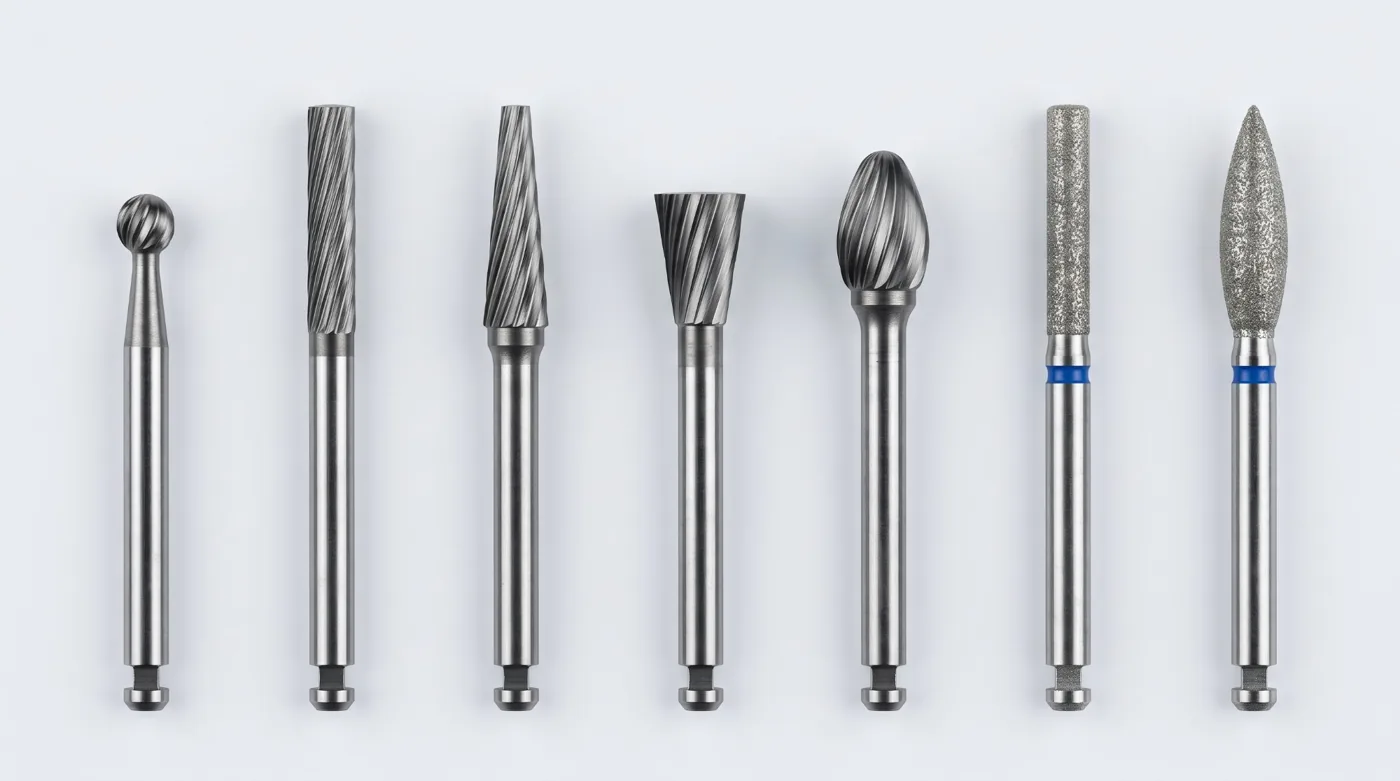
Burs are rotary cutting instruments that mount into the handpiece. They are classified by head shape, material, and clinical indication. Correct bur selection ensures precise preparation and maintains cutting efficiency.
| Bur Type | Shape | Material | Primary Use |
|---|---|---|---|
| Round bur | Sphere Ø 0.6–2.3 mm | Steel / carbide | Initial access, caries removal, retention points |
| Plain fissure (cylindrical) | Flat-ended cylinder | Carbide | Shaping cavity walls, creating parallelism |
| Tapered fissure | Truncated cone narrowing toward the tip | Carbide | Divergent walls for crown preparations |
| Inverted cone | Truncated cone, tip toward shank | Carbide / steel | Retention boxes in Class I–II cavities |
| Pear-shaped (oval) | Rounded tip extension | Carbide | Finishing cavity floors, rounding internal angles |
| Diamond cylinder | Cylinder with diamond coating | Diamond (ISO: blue/red band) | Enamel margin finishing, removing overhangs |
| Diamond taper | Cone with diamond coating | Diamond (coarse/medium grit) | Crown preparation, smoothing line angles |
| Flame-shaped | Elongated tapering head | Diamond | Interproximal areas, crown margins |
| Wheel (disc) bur | Thin disc | Diamond / steel | Separating teeth, shaping proximal boxes |
| Finishing bur | Any shape with fine flutes | Carbide (8–32 blades) | Smoothing restorations, removing flash |
Handpieces and Speed Ranges
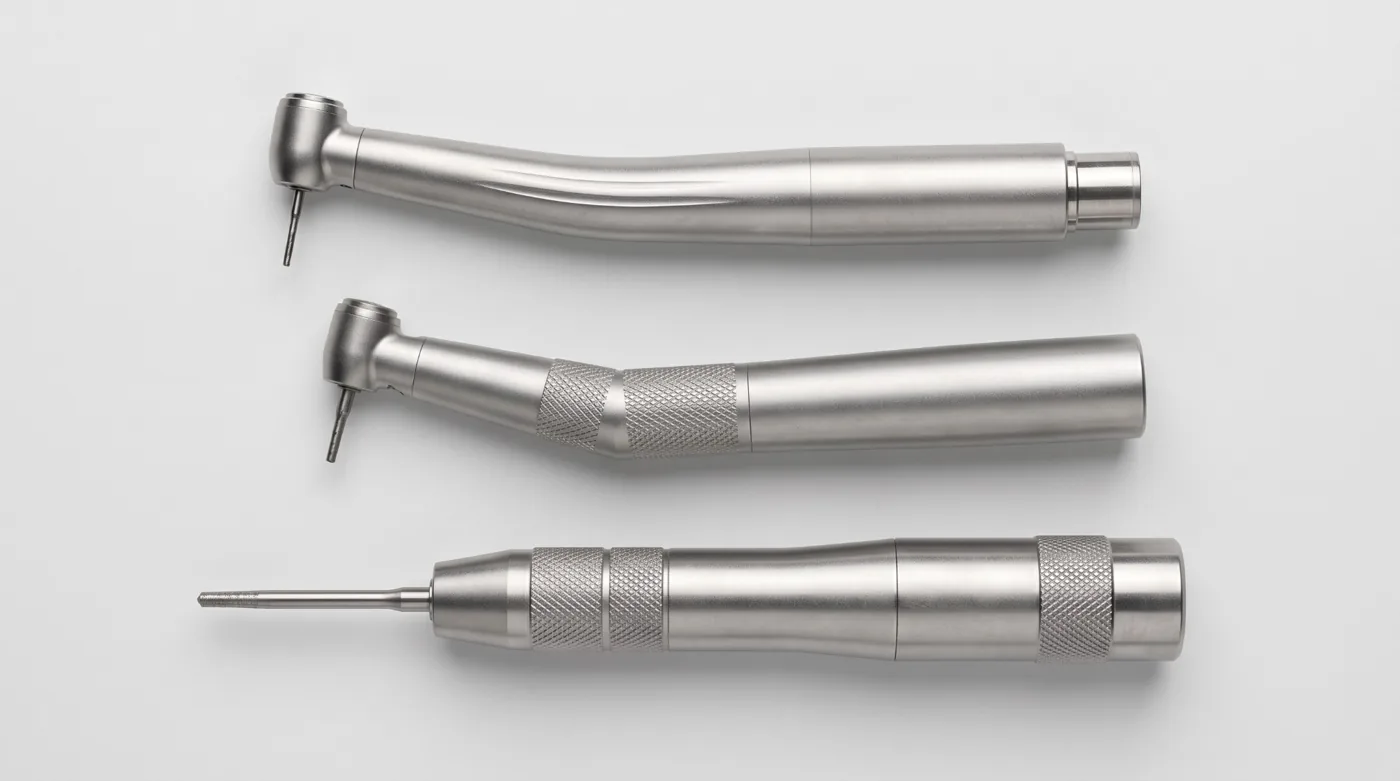
The handpiece determines bur rotation speed and the torque delivered. Handpiece selection is the first step before bur selection: a wrong combination reduces cutting efficiency and increases the thermal load on the pulp.
High-speed (turbine) handpiece — 250 000–400 000 rpm. Air turbine drive, low torque. Mandatory water spray cooling. Used for: cavity access opening, wall shaping, removing unsupported enamel. NOT used for caries excavation — risk of pulpal damage from vibration and overheating.
Contra-angle handpiece (low-speed motor) — Up to 40 000 rpm. Electric motor, high torque. Used for: caries removal with round bur, polishing restorations, condensing amalgam. Provides finer tactile control than the turbine.
Straight handpiece (low-speed motor) — The bur axis coincides with the handpiece axis. Used in the dental laboratory (adjusting prostheses) and for work in the posterior region where direct access is available. Less common in clinical practice.
Endodontic motor (reciprocating/rotary) — 150–600 rpm with precisely controlled torque. Used exclusively with NiTi rotary files (ProTaper, WaveOne, Reciproc). Auto-reverse or auto-stop prevents file fracture at torque limit.
Decontamination and Sterilization
| Method | Finding | Note |
|---|---|---|
| Ultrasonic cleaning | 5–10 min in enzymatic solution | Removes organic debris before disinfection |
| Chemical disinfection | 30–60 min in working solution | Glutaraldehyde 2% or 6% H₂O₂ |
| Steam sterilization (Class B) | 134 °C, 18 min | Gold standard; effective against prions |
| Dry heat (hot-air oven) | 180 °C, 60 min | Acceptable but inferior to steam; not for rubber items |
Summary
Knowing the instrument classification ensures a logical sequence of clinical stages: examination instruments → isolation → high-speed access → low-speed caries removal → adhesive application → restoration → polishing. Each stage requires a specific instrument type — substituting one for another lowers the quality of work and may harm the patient.
Proper care and timely replacement of instruments are a mandatory part of clinical competence. A dull bur overheats dentin, a blunt explorer traumatizes the pulp, and worn polishing discs leave scratches on the restoration.