Pulp inflammation: acute and chronic forms
ICD-10: K04.0
Definition
Pulpitis is inflammation of the dental pulp in response to infectious, mechanical, chemical, or physical irritants. The pulp is a loose connective tissue filling the pulp chamber and root canals, containing blood vessels, nerves, and odontoblasts.
According to WHO data, pulpitis is the second most common reason for dental visits after caries. In 92–95% of cases, the etiological factor is microbial invasion through a carious cavity.
ICD-10 Code: K04.0 — Pulpitis
Normal EPT: 2–6 μA — Healthy pulp
EPT acute: 15–35 μA — Acute pulpitis
EPT chronic: 40–80 μA — Chronic pulpitis
EPT necrosis: >100 μA — Pulp death / periodontitis
Thermal test (+): >30 sec — Pulpitis (pain lingers after removal of stimulus)
Classification
In Kazakhstan the Ministry of Health clinical protocol “Pulpitis” (2015) uses the MMSI classification (1989). All its forms are coded K04.0 in ICD-10; sub-codes such as K04.01 belong to the dental adaptation ICD-DA and are not used in the protocol.
K04.0 Acute focal (partial) pulpitis (AAE: symptomatic irreversible pulpitis) — Inflammation limited to one pulp horn. Acute, paroxysmal pain, predominantly from cold, lasting 10–30 min. Patient can localize the tooth precisely.
K04.0 Acute diffuse (general) pulpitis (AAE: symptomatic irreversible pulpitis) — Inflammation involves the entire pulp. Spontaneous pain radiates along trigeminal nerve branches. Patient cannot localize the tooth. Heat exacerbates pain; cold gives temporary relief.
K04.0 Acute purulent pulpitis (AAE: symptomatic irreversible pulpitis) — Suppurative inflammation of the pulp. Severe throbbing pain with almost no pain-free intervals, radiating along the trigeminal branches. Heat intensifies the pain; cold gives temporary relief. Percussion may be mildly tender.
K04.0 Chronic fibrous pulpitis (AAE: asymptomatic irreversible pulpitis) — Most common form. May be asymptomatic. Mild pain to thermal stimuli that resolves after their removal. EPT 40–60 μA. Slight widening of the periodontal space on X-ray.
K04.0 Chronic gangrenous pulpitis (partial pulp necrosis) — Partial or total pulp necrosis. Characteristic putrid odour. Pain from heat (thermal diffusion to viable nerve tissue). EPT 60–90 μA.
K04.0 Chronic hyperplastic pulpitis — Pulp tissue proliferates through the carious opening forming a polyp. Seen in young patients. Bleeds on probing.
K04.0 Exacerbation of chronic pulpitis (fibrous or gangrenous) — Flare-up of chronic inflammation. Clinical picture resembles acute pulpitis with a history of remission periods. EPT 50–80 μA.
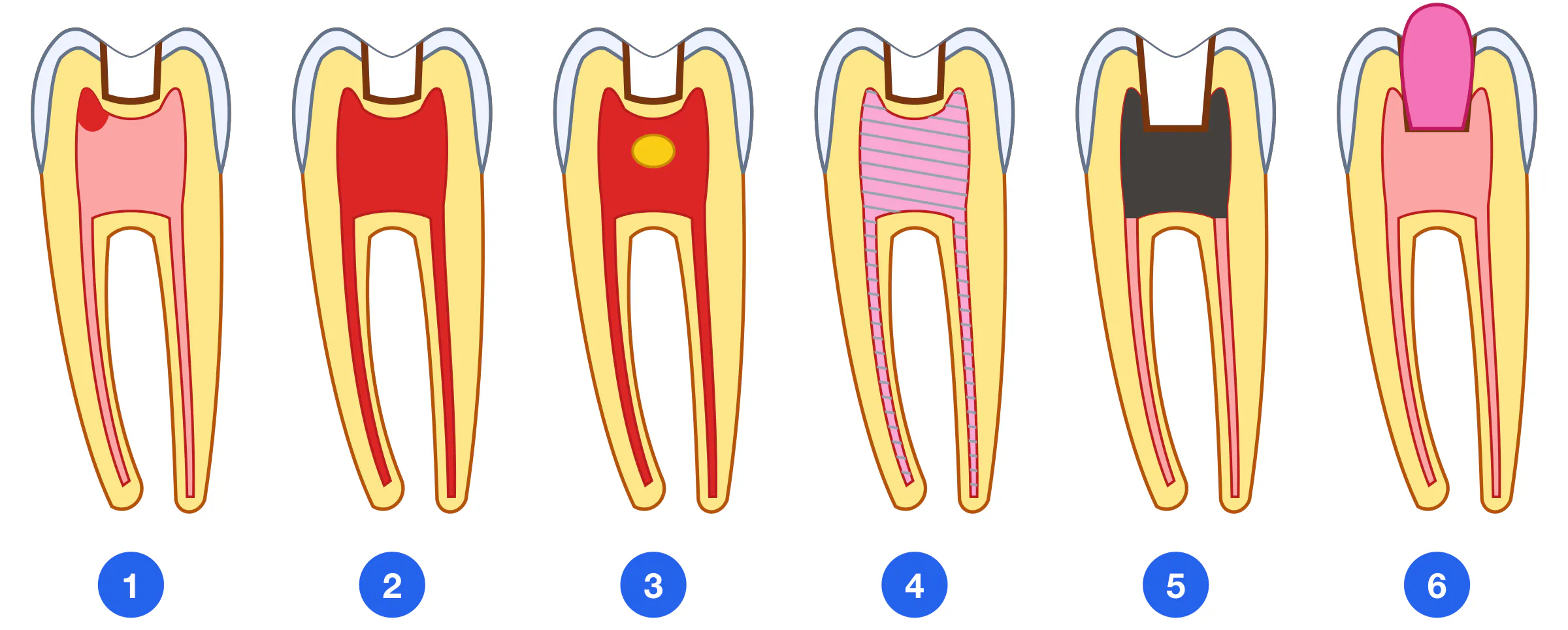
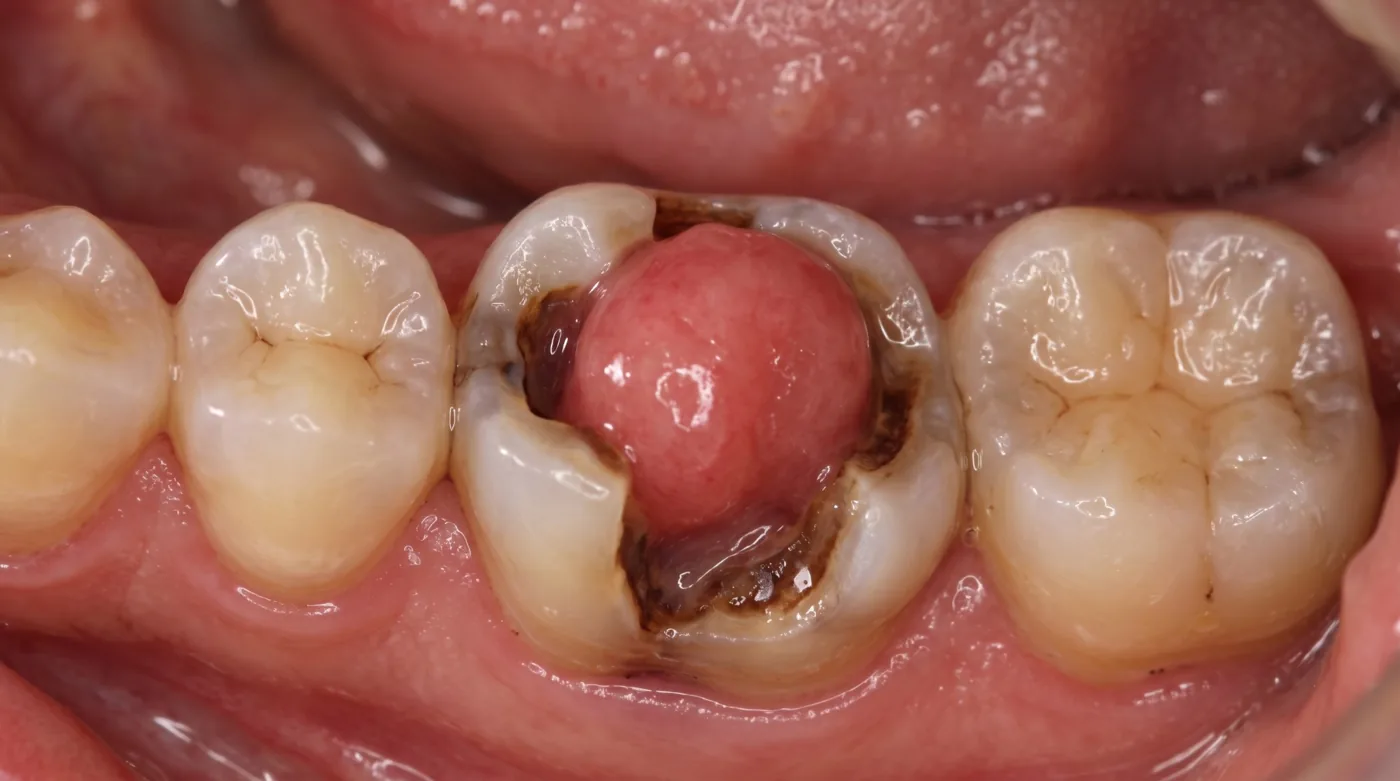
Clinical Features of Acute Pulpitis
Spontaneous pain — Occurs without apparent cause, especially at night. Nocturnal pain is a characteristic (but not pathognomonic — it also occurs in periodontitis) sign of acute pulpitis.
Paroxysmal pain character — Episode lasts 10–30 min (focal) or several hours (diffuse); pain-free intervals shorten as inflammation progresses.
Radiation of pain — In diffuse pulpitis, pain radiates along trigeminal branches: to the temple, ear, occiput, opposing teeth. Patient cannot identify the culprit tooth.
Aggravation by heat in diffuse pulpitis — Heat expands exudate, raising pressure in the closed pulp chamber. Cold provides temporary relief.
Prolonged cold sensitivity in focal pulpitis — Cold pain lasting >30 seconds — the key distinction from caries (<30 sec).
Diagnostic Methods
| Method | Finding | Note |
|---|---|---|
| Probing | Painful at the pulp horn (focal) or across the entire floor (diffuse) | Detects communication with the pulp |
| Cold thermal test | Pain >30 sec after removal of stimulus | Normal: pain subsides within 10–20 sec |
| Heat thermal test | Sharp pain in diffuse; in chronic gangrenous — dull aching pain from heat that subsides slowly | Heat expands exudate |
| Percussion | Painless or mildly tender in diffuse | Sharp percussion pain → periodontitis |
| Electric pulp test (EPT) | Acute: 15–35 μA; chronic: 40–80 μA | Normal 2–6 μA; >100 μA = necrosis |
| Radiography | Carious cavity; possible widened periodontal space in chronic | No periapical change in acute |
Differential Diagnosis
| Feature | Acute pulpitis | Dentinal caries | Acute periodontitis |
|---|---|---|---|
| Spontaneous pain | Yes, paroxysmal | No | Yes, constant, increasing |
| Cold sensitivity | >30 sec | <30 sec | None or mild |
| Heat sensitivity | Aggravated (diffuse) | Moderate | None or aggravated |
| Percussion | Painless or mildly + | Painless | Sharply painful |
| EPT | 15–35 μA | 2–6 μA | >100 μA |
| Nocturnal pain | Yes | No | Yes, constant |
Treatment Principles
Biological (vital pulp therapy) — Preserves pulp vitality. Indicated for reversible forms (hyperaemia, acute focal in young patients). Calcium hydroxide liner placed, cavity sealed. (Calcium hydroxide liner)
Vital pulpotomy — Removal of coronal pulp preserving radicular pulp. Indicated for symptomatic irreversible pulpitis (focal; legacy acute focal) in young patients with incomplete root formation. (Ca(OH)₂ or MTA)
Vital pulpotomy — Removal of the coronal and orifice pulp while the radicular pulp stays vital. Under the Kazakhstan Ministry of Health protocol: acute focal pulpitis, accidental pulp exposure, teeth with incomplete root formation; used in multi-rooted teeth. (Ca(OH)₂ or MTA)
Devital pulpectomy — Arsenic-free devitalising paste applied → pulp necrosis → pulp removed at the next visit. The Kazakhstan Ministry of Health protocol provides for it in all forms of pulpitis and in intolerance to local anaesthetics. Arsenic pastes are not included in the protocol. (Arsenic-free paraformaldehyde-based paste) (2 visits)
Devital pulpotomy — After devitalisation the coronal and orifice pulp is removed; the radicular pulp is impregnated with a resorcinol-formalin mixture and left in the canals. Under the Kazakhstan Ministry of Health protocol: impassable canals, intolerance to anaesthetics, severe general condition. (Arsenic-free paste, resorcinol-formalin mixture) (3 visits)